The first true Pigs were brought to the United States by Hernando de Sota to the Atlantic Coast of Florida in 1539.
The First "Pure Russian" wild boars were brought into the US by Austin Corbin. They were released into a 20,000 acre enclosure in Sullivan County New Hampshire in 1890.
SOME FAST FACTS AS OF 2006: STATES WITH FERAL HOGS: 39, plus 4 Canadian provinces. TEXAS COUNTIES with Feral Hogs, 225 out of 254 counties. HOG POULATION IN TEXAS; 2,000,000 (MILLION)+! NATIONAL POPULATION is estimated at around 4,000,000. ESTIMATED ANNUAL AGG DAMAGE from feral swine $52 MILLION! LANDOWNER ANNUAL EXPENSE to control feral swine $7 MILLION NATURAL LIFE EXPECTANCY OF A FERAL SWINE IS 6 to 8 years. AVERAGE SIZE of feral swine is 100 to 150 pounds, but depending on the region can obtain sizes in excess of 600 lbs. REPRODUCTION OF FERAL SWINE: Once a sow reaches breeding age at 7 or 8 months of age they can be responsible for 1,000 plus feral swine in a 5 year period. The State of Texas had an estimated population of around 2 MILLION at last check. ( If 1/4 are breeding sows!? ) In my opinion the current contribution to the exploding feral swine population is HUMAN IGNORANCE, such as catch and release, or those who feel killing animals is cruel. Allowing them to populate unchecked would be a cruel blow to our native habitat and wildlife!
IN YEARS PAST the major contributor to the feral hog population was attributed to the now obsolete practice of "free roam farming."
Hog Farmers would brand/mark their hogs and release them into the open woods to roam free breed and grow.
The downfall of Free Roam Farming is due to 2 factors. The first was dwindling space due to development and crop farms. The second was the demand for "Hard
Fat.
The average litter of a feral sow is 4-6. This depends greatly on the breed of the feral hog and the food availability. Feral Sow which have just escaped or feral sow that retain much of their domestic breeding will have larger litters.
Wild Hogs have a very highly developed sense of smell which will match or even rival that of other competing wild life.
According to many studies, hogs are very intelligent. Undoubtedly they are the most intelligent animal in the woods. Any hunter or trapper who hunts them specifically can easily make note of this fact. Wild Hogs will eat both Plants and Animals. This classifies them as omnivores. Texas and New Hampshire are the only 2 states where true Russian Boar may still exist on a rare basis. BUT, with hunters buying and releasing TRUE RUSSIAN BOARS into the wild this is ever changing. Wild Boar are both good and safe to eat when prepared properly. Wild Boar really do have a shield. This shield is considered scar tissue or a callus which becomes harder and thicker with age. The shield covers the hog, beginning from the neck to the last rib. This shield is generally about 1 inch thick, but can be more than 3 inches thick and is found mainly on the boar. It's purpose is to protect the boar during battles with each other.
The weight of fully matured feral hogs will vary from 200 pounds to over 700 pounds.
Characteristics of the True Wild Boar or Russian Boar:
The following information source came from the Noble Foundation.
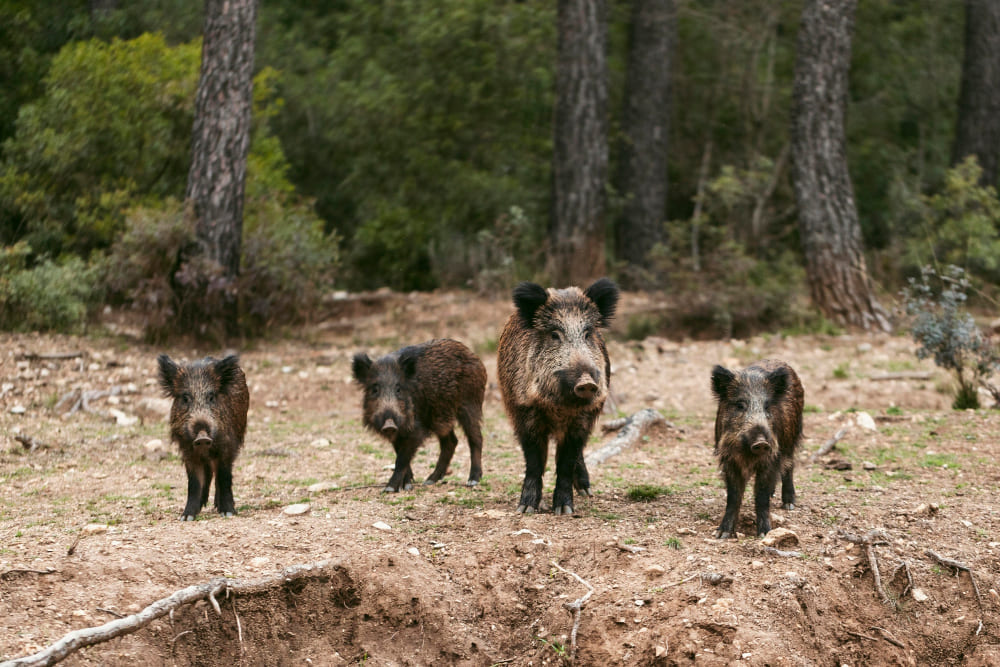
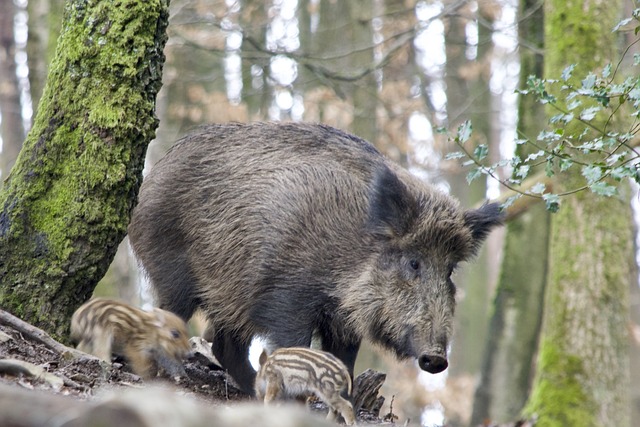
Feral hogs (Sus scrofa), which are wild swine from domestic ancestry, belong to the family Suidae. Actually, there are three types of wild hogs found in the United States: feral hogs, Eurasian wild boar (Russian) and hybrids between these two types. The hybrid of course is a cross between the feral hog and the Russian wild boar. In the United States (U.S.), California, Florida and Texas have the highest numbers of feral hogs. Some of the Hawaiian Islands have substantial populations as well, and Oklahoma's population is healthy and growing. Even though these states and many others have populations of feral hogs, they are not indigenous (native) to the United States. A hog-like animal, the javelina or collared peccary (Tayassu tajacu), is native to the southwest U.S. However, the feral hog is a different species, genus and family from the javelina which belongs to the family Tayassuidae. Native to the Southwest U.S., the javelina is often confused with the feral hog. Javelinas are hog-like in appearance, however, they are not closely related. Photo: Dale Rollins Ancestors of our swine date back to the Miocene. During the period when the world was shifting and forming new continents, the swine family was excluded from the new world. It was probably not until the discovery of the new world by European man that swine found their way into what is now the U.S. Early explorers such as Hernando Cortes and Hernando de Soto are largely responsible for their introduction. The swine these explorers brought over were domesticated and it was not until the 1930's that the Russian wild boar was introduced. Today, there are areas in the U.S. where the pure Russian wild boar (native to European and Asian continents) can still be found due to importation for sport hunting. However, most feral hogs are from domesticated swine. Feral hogs are in fact wild but are not a different species than domestic hogs or Russian boars. Webster's dictionary defines feral as: having escaped from domestication and become wild. Hence, all feral hogs in the U.S. up until the 1930's were from domestic stock. In a few areas where the Russian boar was imported for sport hunting, escapes have occurred resulting in feral / Russian crossbreeding. The feral hog has been very successful in expanding its range and increasing its numbers. Its success can be attributed to several factors: free ranging method of husbandry; its introduction and reintroduction by hunters; water development in arid areas; improved range condition through better livestock grazing practices; and its ability to reproduce quite rapidly. Feral hog populations have also benefited from increased disease control in the domestic livestock industry. Ongoing studies are being conducted to determine distinguishable characteristics between domestic, feral, Russian and feral/Russian crosses through DNA testing, skull measurements, external body measurements, coat coloration patterns, bristles and other criteria. Much has been learned, but definite determinants have not yet been developed. Therefore, it should be pointed out that the following descriptions are general and relative in nature. In general, a feral hog looks like its domestic counterpart. Coat coloration patterns can vary from solid black, brown, blond, white, or red to spotted (various combinations of black, white, red, and brown) or belted. A belted hog has a white band across the shoulder and forelimbs. Feral hog bristle length is generally longer than a domestic hog but shorter than the hybrid or pure Russian. A feral hog can reach three feet in height and over 300 pounds in weight; however, the average sow weighs approximately 110 pounds and the average boar weighs 130 pounds. A boar has four continually growing tusks that can be extremely sharp, and may reach five inches before they are broken or worn from use. Tusks are used for defense and to establish dominance during breeding. A male feral hog also develops a thick, tough skin composed of cartilage and scar tissue on the shoulder area which is sometimes referred to as a shield. The shield develops continually as the hog ages and through fighting. Tusks which are found on the lower jaw, or mandible, can be extremely dangerous when put to use by a mature boar. The upper tusks, or whitters, help keep the lower tusk extremely sharp. The pure Russian boar is generally light brown or black with a cream or tan color on the tips of the bristles. Its underside is lighter in color and its legs, ears and tail are darker than the rest of the coat. Its bristles are the longest of the three types of wild hogs. Pure Russian boars have longer legs and snouts and their head to body ratio is much greater than a feral hog. They also tend to have shorter, straighter tails. Depending on ancestry, the physical characteristics of wild swine can vary greatly. Size, shape and color can all fluctuate. And all types of wild swine can raise their hair on the back of their necks giving them the look of a razorback. Feral/Russian crosses exhibit combinations of features from both the feral and the Russian hogs. Bristle length in the hybrid is longer than the feral but shorter than the Russian. Hybrids exhibit the smallest bristle shaft diameters. Striped patterns on the young are sometimes thought to be an indicator of pure Russian or feral/Russian crosses; however, this pattern has also been found in feral piglets and therefore is not a reliable method of identification. Another possible ally we have to aid in the control of feral hogs is the coyote. Piglets and small hogs can provide an excellent dinner for a coyote. There are known instances of an increase in the coyote population as feral hog populations increase. However, the extent that the coyote can control a hog population remains to be documented. Owls and bobcats also have been reported as predators of piglets and small pigs. In other parts of the U.S., mountain lion and black bear are also known predators. Feral hogs represent many unknowns to biologists, wildlife managers, landowners and hunters, and as one biologist so precisely put it, "feral hogs are an ecological black box." Feral hogs in some areas have been credited with the perceived decline of the quail population, yet there are other areas where quail numbers are high and feral hogs are everywhere. They also receive credit for having a significant impact on wild turkey nests, various plant species and entire ecological systems. However, the actual effect hogs have on our environment remains unknown. More research and practical knowledge are needed to give us a better understanding of the feral hog and its influence on game and non-game species as well as the environment and its ecosystems. We do know feral hogs can harbor and transmit some diseases and parasites to livestock and humans. We know feral hogs can have a significant negative impact on some livestock operations through depredation and damage to facilities and fences. Farmers also share a significant portion of the damage caused by the rooting of fields and depredation of crops. Feral hogs provide excellent table fare, represent a challenging game species to pursue with weapon or dog, and compete with the white-tailed deer in some areas as the most popular animal to hunt. As mentioned, there are many pro's and con's regarding the status of feral hogs and there always will be as long as we have biologists, farmers, ranchers, hunters, and of course, the feral hog. The feral hog has received a lot of credit for various disease and depredation problems but is sometimes wrongly accused, due to the destructive nature of some of their other activities. Feral hogs, like all animals, are susceptible to many infectious and parasitic diseases but probably cause more problems through rooting, wallowing and depredation. However, if caution is not used when handling hogs or when feral hogs are around domestic livestock, disease can be a problem. Disease and depredation, which are already problems in some areas, will only increase as hog populations increase. There has been little documentation of many of the diseases of feral hogs and their spread to livestock and humans. However, there are two diseases associated with feral hogs that are documented fairly well - pseudorabies and swine brucellosis. Other diseases hogs may carry are tuberculosis, anthrax and tularemia. Pseudorabies is a viral disease of the central nervous system that can affect domestic and feral hogs and fatally affect cattle, horses, goats, sheep, dogs and cats. Wild animals such as raccoons, skunks, opossums and small rodents can also be fatally infected. Symptoms of the virus in these animals are anorexia, excessive salivation, spasms, convulsions and intense itching followed by paralysis and then death. Pseudorabies is not related to the rabies virus and does not infect people. This disease is of special concern to domestic hog owners because it can weaken pigs and cause abortions and stillbirths, thus decreasing production and profits. Once infected, the hog is a lifetime carrier and will periodically shed the virus through the mouth and nose. Transmission of the disease can be through direct contact, contaminated feed and water, ingestion of infected tissues, or contaminated trailers. Swine brucellosis can cause infertility in boars and abortions in sows. This disease can also cause a loss of production and profit in domestic swine operations. Swine brucellosis is transmitted through reproductive discharges such as semen and afterbirth and once infected a hog is a carrier for life. The only effective way to control this disease is to test and remove infected individuals, a task impossible to do in a wild population. Swine brucellosis is contagious to humans and symptoms may range from severe flu-like symptoms to arthritis or meningitis. There is no cure for this disease in animals while humans can be treated with antibiotics in an attempt to clear the infection. The main reservoirs of tuberculosis infection are in man and cattle, however feral hogs have been found infected with (Mycobacterium bovis) the same strain of tuberculosis found in man and cattle. Although the M. bovis strain has been detected in feral hogs, they are not very susceptible. The infection is most often contracted by ingestion of infected materials. Lesions on the lymph nodes are good indicators of an infected hog. Fortunately, due to extensive control measures, this disease is not common. Feral hogs may also carry another strain of tuberculosis, M. avis, contracted by eating dead birds. This strain is not contagious to humans. Anthrax is a serious soil-borne disease that is most commonly associated with neutral or alkaline soils that serve as reservoirs for the organism's spores. Recognized endemic areas include portions of Texas, Louisiana, California, Arkansas, Mississippi, Nebraska, South Dakota and small areas in other states. Even within these areas, anthrax occurs irregularly and primarily when the minimal daily temperature is above 60 degrees. Although uncommon, the feral hog may become infected when feeding. Humans can contract this disease from contaminated animals or soil. The disease in humans is often fatal if not promptly treated with antibiotics. Tularemia is not commonly found in feral hogs but they can contract it through direct contact or ingestion of contaminated animal carcasses. Ticks are a good vector as well as a reservoir and the most common source of infection for man. Persons who dress, prepare or eat improperly cooked feral hogs or other wild game are also at increased risk. Feral hogs harbor several parasites some of which might pose problems for man or other animals. Fleas, hog lice and ticks are some common external parasites that a hog may acquire. It is thought that feral hogs do not occupy an area long enough or in sufficient numbers to get infected with large numbers of internal parasites or facilitate transmission to humans. However, internal parasites can occur in feral hogs and may include roundworms, kidneyworms, lungworms, stomachworms, whipworms, liver flukes and trichinosis. Trichinosis infections in humans are established by consumption of undercooked, infected pork. Ranchers, farmers and hunters need to be aware of these potential diseases and take every precaution to avoid infection. Livestock owners should be sure all of their animals are vaccinated, especially when there is a chance they may have contact with feral hogs. There are state and federal laws governing the transport and relocation of feral hogs. Blood tests are required by law before feral hogs can be relocated. Hunters, trappers, butchers and wildlife managers should always wear rubber gloves when handling or dressing feral hogs. Try to avoid contact with reproductive organs and blood, and wash thoroughly after contact. Hunters and chefs cooking feral hog meat should make sure it is thoroughly cooked. We do know feral hogs can harbor and transmit some diseases and parasites to livestock and humans. We know feral hogs can have a significant negative impact on some livestock operations through depredation and damage to facilities and fences. Farmers also share a significant portion of the damage caused by the rooting of fields and depredation of crops. Feral hogs provide excellent table fare, represent a challenging game species to pursue with weapon or dog, and compete with the white-tailed deer in some areas as the most popular animal to hunt. As mentioned, there are many pro's and con's regarding the status of feral hogs and there always will be as long as we have biologists, farmers, ranchers, hunters, and of course, the feral hog. |
